FCT COE INTRODUCES DIGITAL CARD READERS TO STRENGTHEN EXAMINATION INTEGRITY
By: Halimah Yahaya
In a significant step towards digital transformation in higher education, the Provost of the FCT College of Education, Zuba–Abuja, Dr. Sule Mundi, has introduced the use of digital card readers to verify students’ identity before they are allowed into examination halls.
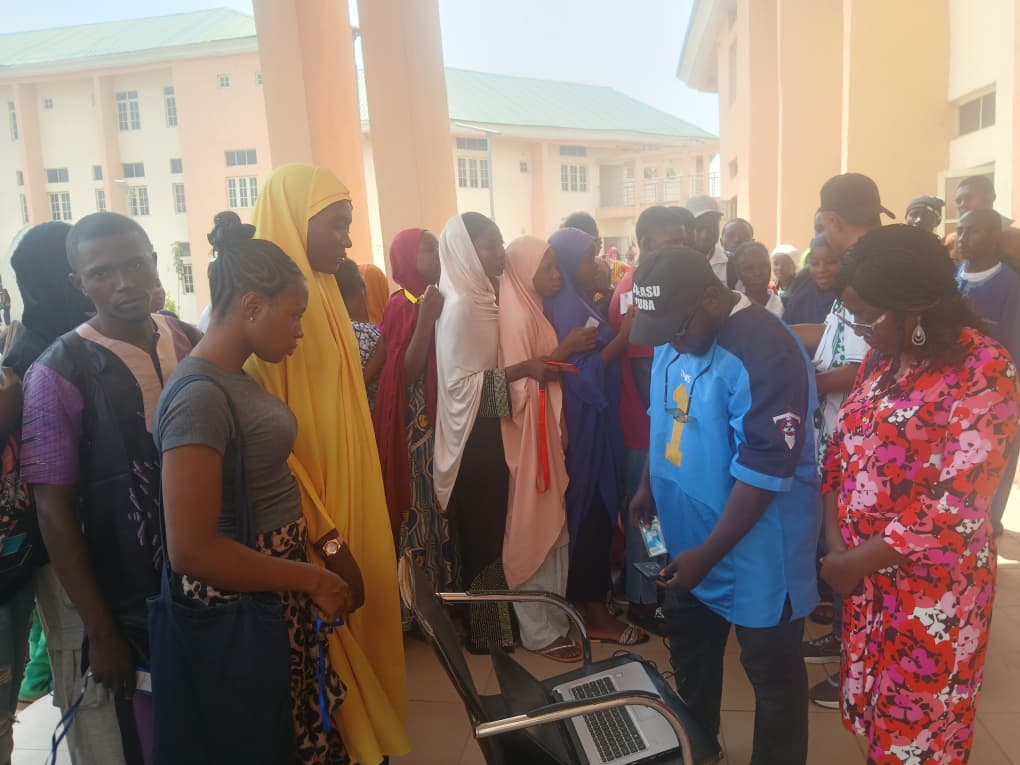
The innovation, which requires students to scan their digital identity cards using a QR-code-enabled card reader, is designed to promote transparency in the conduct of examinations, eliminate impersonation, and drastically reduce cases of examination malpractice.
The initiative forms part of the college’s broader digitalisation drive under the leadership of Dr Mundi, who has consistently emphasised the need for the institution to adopt modern technology in its academic and administrative processes.
Speaking in a chat with the College’s Public Relations team, the Deputy Provost (Administration), Dr. (Mrs) Gbemisola Olotu, who represented the provost, described the initiative as a forward-looking innovation aimed at aligning the institution with global best practices in education.
According to her, the college management recognised that education systems around the world are rapidly evolving through the integration of information and communication technology, making it necessary for the institution to move away from traditional methods.
“Innovation is everywhere and education itself is dynamic. The way things were done years ago is no longer the same today. Everything now revolves around ICT and digital platforms. We now have virtual learning systems and blended learning where lectures are conducted both physically and online. Some lecturers in the college have already adopted this approach,” she said.
Dr. Olotu explained that the introduction of the digital ID card system for students was, therefore, a deliberate move by the management to incorporate technology into the examination process.
“Why should we continue to operate in an analogue system when it comes to examinations? That was what informed the decision of the management to introduce the digital ID card system. Last year, students in 200 and 300 levels were captured and issued the digital identity cards,” she stated.
She further explained that as preparations for the semester examinations began, the management approached the Provost to commence the implementation of the innovation.
“The Provost gave his approval and directed that we proceed. The programmer was invited and we outlined the key features required on the platform. These include the student’s matriculation number, passport photograph, school fees payment receipt, and course registration form,” she said.
According to her, once the QR code on the ID card is scanned using the card reader, the student’s details automatically appear on the device being used for verification.
“This means that if a student has not paid school fees or has not completed course registration, the system will immediately detect it and such a student will not be allowed into the examination hall,” she explained.
Dr. Olotu noted that beyond verifying students’ eligibility, the system will also help address the issue of impersonation and significantly curb examination malpractice.
“In the past, students used to come into the examination hall carrying payment receipts and registration forms, and sometimes those documents contained information that could aid malpractice. With this innovation, students no longer need to carry any paper into the examination hall. All they need is their digital ID card,” she said.
On challenges encountered in the course of implementing the innovation, Dr. Olotu identified network connectivity as a major factor.
She revealed that the college had earlier partnered with Airtel to provide network services across the campus to support digital operations.
“Last year, Airtel came to enable the network in the college and it worked effectively. However, the service still needs to be extended to the Mini Campus. For some reasons, the network was temporarily disabled and we are currently waiting for it to be restored,” she said.
Despite the temporary setback, she noted that the college management has already made alternative arrangements to ensure that the examination process runs smoothly.
“We are making provisions for exam officers to purchase data, especially since they have laptops provided by the college. Each school was also given two card readers, which can be used alongside mobile phones to scan the students’ ID cards,” she explained.
Dr. Olotu expressed optimism that once the network service is fully restored across the campus, the digital examination verification system will operate seamlessly and further strengthen academic integrity within the institution.