NIGERIA RECORDS HISTORIC BREAKTHROUGH AS OVER 100 MILLION PEOPLE EXIT NTD TREATMENT, FG REAFFIRMS 2030 ELIMINATION TARGET
… As FCT, 36 States get anti-rabies vaccine and anti-snake venom
By: Prudence Okonna
Nigeria has recorded one of its most significant public health milestones, removing more than 100 million people from treatment for major Neglected Tropical Diseases (NTDs), as the Federal Government renewed its commitment to eliminate the diseases by 2030.
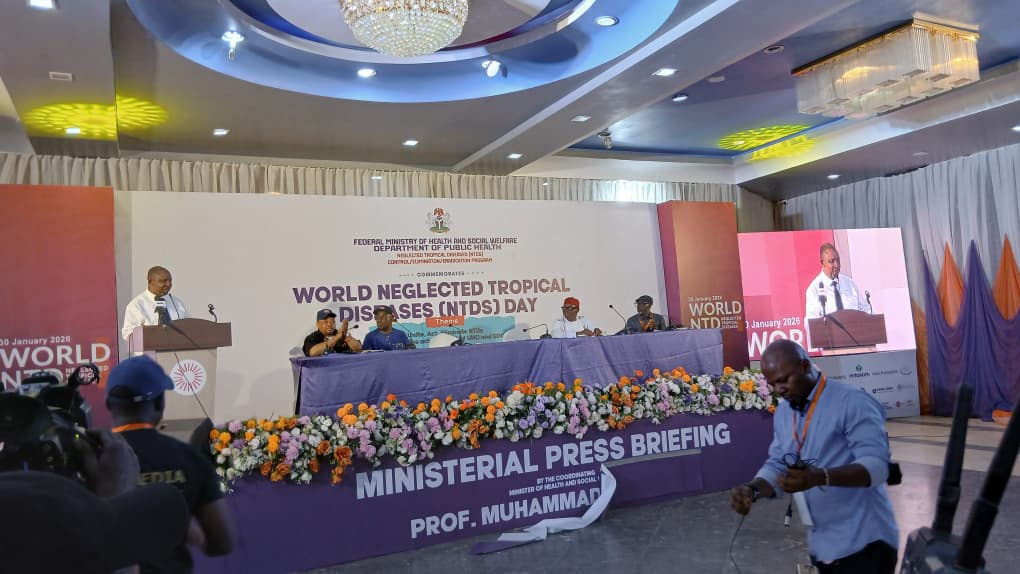
The Federal Ministry of Health and Social Welfare (FMOHSW) disclosed this during a ministerial press briefing in commemoration of the World Neglected Tropical Diseases (NTD) Day, Thursday, 29 January 2026.
Minister of State for Health and Social Welfare, Dr Isiaq Adekunle Salako, described NTDs as not only a health concern but a social justice issue, driven by poverty, inequality, weak health systems and limited political attention.
Dr Salako, who was represented by the Permanent Secretary, Federal Ministry of Health and Social Welfare, Daju Kachollom, noted that while NTDs affect over one billion people globally, Africa bears nearly 50 per cent of the burden, with Nigeria accounting for about 25 per cent of cases on the continent.
According to the Minister, Nigeria currently has over 200 million people at risk of at least one NTD, with 165 million requiring preventive chemotherapy.
Despite this, the country has made remarkable progress through sustained interventions and partnerships.
Providing details of these achievements, the Director and National Coordinator of Neglected Tropical Diseases, Federal Ministry of Health and Social Welfare, Dr Fatai Adeniran, revealed that Nigeria has removed 59 million people from treatment for onchocerciasis (river blindness), a feat he said no other country has achieved.
Dr Salako added that 119.9 million Nigerians have also been removed from treatment for lymphatic filariasis (elephantiasis), while 36 million people no longer require treatment for trachoma, leaving only about four million still under intervention.
“These are quick wins. From the trajectory, Nigeria is clearly on track to meet the 2030 elimination target for these diseases.” Adeniran said.
The Minister further highlighted that mass drug administration for trachoma has been stopped in 118 out of 133 local government areas, while only 15 LGAs still require ongoing treatment.
He also noted the digitisation of the national NTD database, improved surveillance systems, and the procurement and distribution of anti-rabies vaccines and anti-snake venom across states and the Federal Capital Territory.
On leprosy control, the government reported steady progress through early case detection, enhanced contact tracing, and the expanded rollout of single-dose rifampicin for post-exposure prophylaxis, supported by grants from the Sasakawa Health Foundation.
Digital tools such as QGIS mapping and the Leprosy Elimination Monitoring Tool are also being used to guide data-driven interventions and reduce stigma.
Dr Salako stressed that health is on the concurrent legislative list, calling on states and local governments to take greater ownership of NTD and leprosy control through strengthened surveillance, budgetary provisions, and integration into primary healthcare services.
He also linked NTD elimination to broader national reforms, including the Nigeria Health Sector Renewal Investment Initiative and President Bola Ahmed Tinubu’s healthcare value chain reforms, which aim to boost local pharmaceutical manufacturing and ensure sustainable access to essential medicines.
The Minister concluded with a call for stronger collaboration among government agencies, development partners, civil society, the private sector, and the media, warning: “Let us not allow neglected tropical diseases to result in neglected people.”
While thanking partners, including WHO, UNICEF, USAID, NGDOs, and the organised private sector for their sustained support, he reaffirmed Nigeria’s resolve to achieve universal health coverage, the Sustainable Development Goals, and the eradication of poverty through the elimination of NTDs.
Responding to questions on public responsibility, Dr Adeniran emphasised the importance of improved water, sanitation, and hygiene (WASH) practices, noting that most NTDs thrive in environments with poor living conditions.
He therefore urged communities to actively participate in awareness campaigns and support community-directed drug distribution programmes.
In a similar vein, Sightsavers Nigeria, over the past two years, has restored hope to 3,343 Nigerian Men after a successful hydrocele surgery across Kaduna, Kebbi, and Benue states. In Benue State, brothers Bem Bajah, a 65-year-old retired lecturer, and Bajah Terfa Robert, a 56-year-old public servant, both found themselves battling hydrocele within the same family. While pain limited Bem Bajah’s intimacy and comfort, embarrassment forced Terfa Robert to abandon trousers altogether.
“Even the size alone made me uncomfortable,” Bem Bajah admitted.
Abuja Digest reports that the theme for 2026 World NTD Day, annually commemorated on January 30th, is to unite, act, and eliminate NTDs, even as the WHO is urging countries to build a safer and more resilient world for everyone by investing in better tools, systems, approaches, and partnerships so that domestically owned and financed NTD programmes are sustainable.