NIGERIA, JAPAN STRENGTHEN TIES: EDUCATION, ABUJA MASTER PLAN TOP AGENDA AS WIKE, SUZUKI MEET
By: Wisdom Acka
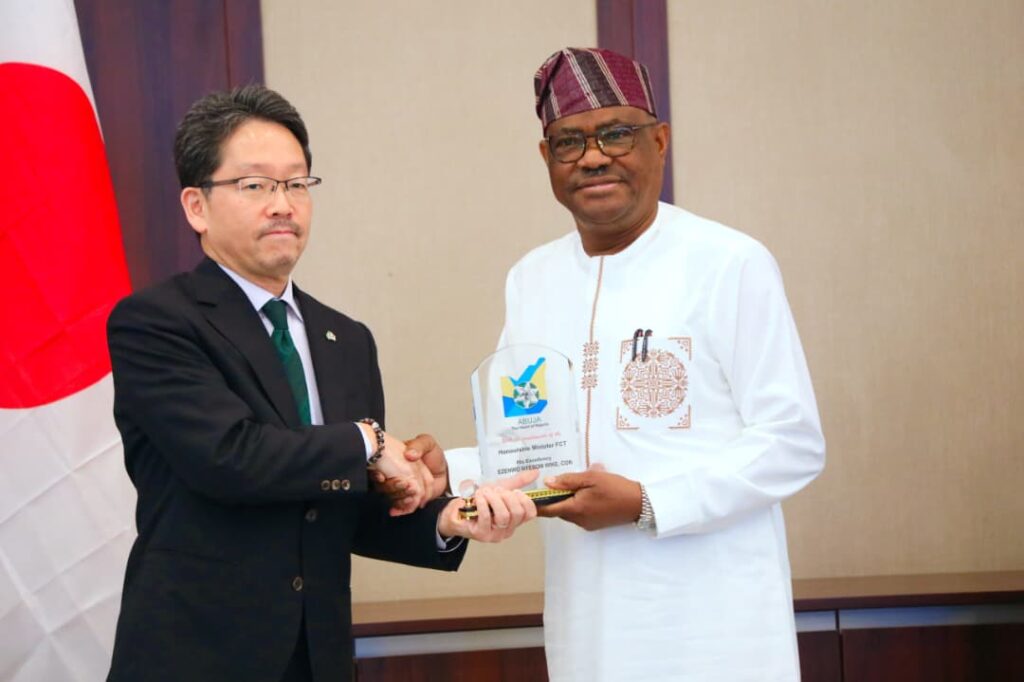
The Minister of the Federal Capital Territory (FCT), Barrister Nyesom Wike, and the Japanese Ambassador to Nigeria, Mr. Hideo Suzuki, on March 24, 2026, held high-level talks aimed at deepening bilateral cooperation.
The meeting, held at the official residence of the FCT Minister in Life Camp, Abuja, highlighted Japan’s ongoing commitment to Nigeria’s growth through key initiatives focused on education, urban development, and technical assistance.
Wike commended Japan’s contributions to Nigeria’s education sector, facilitated through the Japan International Cooperation Agency (JICA). He specifically acknowledged the country’s support in building schools, teacher training programs, and nutrition projects, which align with the federal government’s education reform agenda.
He told the Ambassador, “Your interventions in literacy, education, and health have been invaluable. The training of Nigerian teachers in Tokyo has particularly raised standards in our schools.”
A major highlight of the discussions was the Abuja Master Plan, originally designed by Japanese experts. The Minister revealed that Japanese technical teams are collaborating with the Federal Capital Development Authority (FCDA) to review and update the blueprint for future infrastructure projects.
“This partnership is critical for Abuja’s sustainable development. We are committed to working closely with Japan to ensure the Abuja Master Plan aligns with President Tinubu’s vision for a modern capital city,” he emphasized.
The talks also explored opportunities in agriculture, with both parties agreeing to enhance cooperation in agribusiness and food security. Wike urged Japanese investors to explore Abuja’s potential, pledging government support for mutually beneficial ventures.
“We appreciate Japan’s trust and will ensure these initiatives yield tangible results for our people,” he assured.
The Minister commended Japan’s longstanding support, noting its alignment with Nigeria’s “Renewed Hope Agenda” for job creation and urban development.
Both parties agreed to intensify technical exchanges, with plans for Nigerian officials to visit Japan for further discussions on priority sectors.
Earlier, the Japanese Ambassador to Nigeria reaffirmed his country’s confidence in Nigeria’s leadership, assuring continued support through JICA and other partnerships.
Suzuki highlighted JICA’s achievements across key sectors, including water, waste management, power, health, and education, with ongoing projects valued at millions of dollars.
He outlined some of the contributions, such as a $9 million solar-powered water treatment plant that generates 1,500 megawatt-hours annually and reduces electricity costs by ₦31 million yearly.
In waste management, the envoy disclosed that JICA strengthened the Abuja Environmental Protection Board’s capacity and developed a healthcare waste management plan approved by the FCT Minister.
The power sector also benefited from a $12 million grant to improve electricity supply reliability and reduce transmission losses, he revealed.
In the health sector, Suzuki disclosed that JICA’s $11 million grant supported the Nigeria Centre for Disease Control (NCDC) by establishing a BSL-3 laboratory and enhancing diagnostic capabilities for infectious diseases.
He added that his country has carried out nutrition programs since 2019, aimed at improving maternal and child health, while agricultural projects since 2020 have boosted incomes for smallholder farmers in the FCT and surrounding regions.
The Ambassador also spoke on education, revealing that JICA has conducted many capacity-building initiatives, including partnering with the Universal Basic Education Commission (UBEC) to introduce digital mathematics learning apps and distribute textbooks in FCT public schools.
Over 35 FCTA personnel, according to him, have also received training in Japan since 2023, covering diverse fields to strengthen institutional capacity.
On the Abuja Master Plan review, Suzuki stated it was a major focus of the collaboration, stressing it is aimed at modernizing the 1979 blueprint to meet the city’s needs until 2050.
He stated that the project emphasizes economic growth, climate resilience, and social inclusion, with technical working groups already operational.
A study tour to Japan for FCT officials is planned, with the Minister invited to lead the delegation for high-level discussions.