WORLD BANK, FCTA REVAMP 20 PRIMARY HEALTHCARE CENTRES TO CURB MATERNAL, CHILD MORTALITY
By: Wisdom Acka
The Federal Capital Territory Administration (FCTA), in partnership with the World Bank and the National Primary Health Care Development Agency (NPHCDA), has upgraded and equipped 20 Primary Healthcare Centres (PHCs) across the six area councils of the FCT.
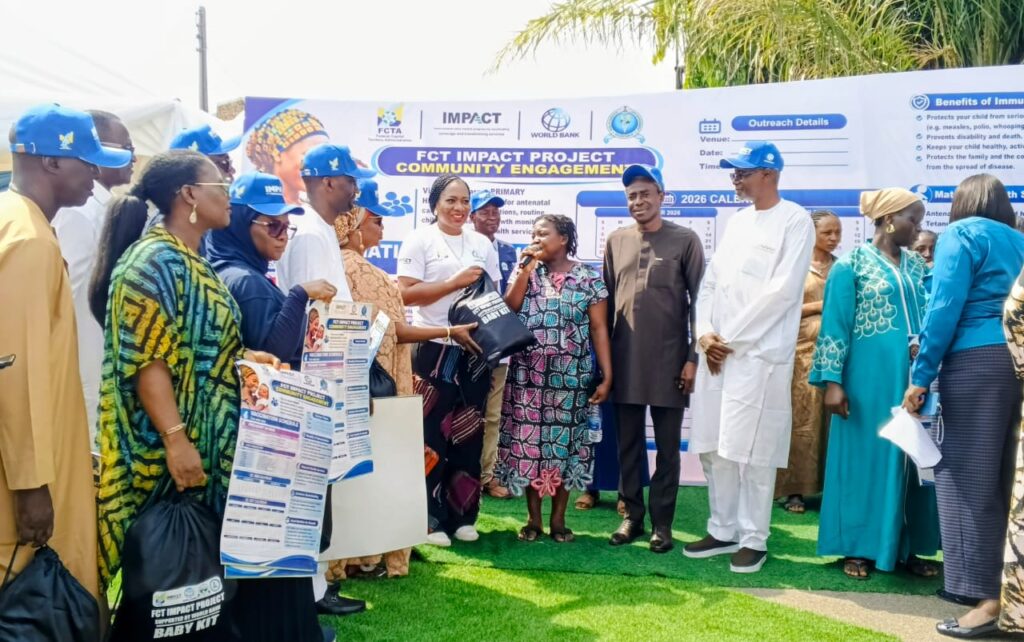
Mandate Secretary, Health Services and Environment Secretariat, Dr. Adedolapo Fasawe, made this disclosure during a community engagement at the Model Primary Health Care Centre in the FCDA Owner Occupier estate on Monday 23 November, 2026, Kubwa, Abuja.
Dr. Fasawe stated that the development would drastically reduce maternal and under-five mortality in the nation’s capital.
She stressed that the initiative goes beyond routine medical outreach to guarantee accessible, affordable, and quality healthcare at the grassroots in line with President Bola Ahmed Tinubu’s Renewed Hope Agenda.
Dr. Fasawe explained that the FCTA is directly tackling the three major drivers of maternal mortality -delays in seeking care, lack of access to health facilities, and inability to afford treatment, through a combination of upgraded infrastructure, free health insurance, and emergency transport services.
She noted that under the World Bank-supported Immunisation Plus and Malaria Progress by Accelerating Coverage and Transforming Services (IMPACT) Project, the selected PHCs have been fitted with modern medical equipment and staff accommodation
According to her, the renovated health centres with accommodation were designed to enable round-the-clock operations, and 24-hour electricity powered by solar systems and backup generators.
Highlighting the link between infrastructure and healthcare delivery, the Mandate Secretary commended the Minister of the Federal Capital Territory, Barrister Nyesom Wike, for massive road rehabilitation across satellite towns and rural communities.
She noted that improved road networks have slashed ambulance response times—such as reducing travel from the city centre to Kubwa General Hospital from one hour to 20 minutes.
To ensure pregnant women and other residents are never stranded during emergencies, Dr. Fasawe disclosed that a community ambulance emergency transport scheme has been unveiled in collaboration with the National Union of Road Transport Workers (NURTW) and commercial drivers operating cars, buses, tricycles, and motorcycles.
The Secretary explained that the scheme involves a situation where registered drivers earn ₦10,000 per drop for conveying women in labour to health facilities, alongside a toll-free 112 emergency ambulance response line.
She demonstrated the efficacy of the response system live during the event by having a random resident place a call to the emergency line, resulting in the prompt arrival of an ambulance, assigned to Zuba area, in about three minutes.
Dr. Fasawe, who presented free NPHCDA Mama Kits containing essential delivery supplies to pregnant women in attendance, added that at least 1,000 vulnerable residents at the engagement were being enrolled free of charge into the FCT Health Insurance Scheme.
She explained that the health care programmes were made possible through the Basic Healthcare Provision Fund (BHCPF) of President Bola Tinubu.
The Secretary also disclosed that the insurance coverage will grant the pregnant women one year of free medical care across public and accredited private hospitals, including Nizamiye and Saad hospitals, as well as free caesarean sections under the BEmONC and CEmONC programmes.
Urging community leaders and residents -including persons living with disabilities -to take ownership of the renovated facilities and report any form of extortion, she stressed that all primary healthcare services under the scheme are completely free and insisted that quality healthcare is a fundamental human right rather than a luxury.
Earlier, Executive Secretary of the FCT Primary Health Care Board, Dr. Dan Gadzama, revealed that although the FCT was initially excluded from the Immunisation IMPACT component when the project began in 2021, Dr. Fasawe’s persistent engagement with the World Bank led to the signing of a Service Level Agreement in February 2025, first disbursement in September 2025, and a one-year extension to December 2026.
Dr. Gadzama stated that the 20 renovated facilities were selected through rigorous data analysis to close critical healthcare gaps, adding that the Board has trained over 250 healthcare workers.
He also revealed that it has procured more than 70 laptops and tablets to strengthen health data reporting, distributed Mama Kits across facilities, and partnered with security agencies and local communities to sustain service delivery in hard-to-reach areas.
Also speaking, the Senior Health Specialist with the World Bank and Task Team Leader of the IMPACT Project, Dr. Onoriode Ezire, commended the FCT Administration for the pace and standard of its PHC upgrades, noting that Abuja had outperformed several states that joined the programme two years earlier.
Recalling his role in drafting the legislative framework that established the FCT Primary Health Care Board, Dr. Ezire urged mothers, families, and community members across the territory to patronise the upgraded health centres and utilise available feedback channels to ensure continuous accountability and improved health outcomes.
Bwari Area Council Chairman, Joshua Ishaku who was represented by Supervisory Councillor, Mrs Fidelia Onwuachonam, thanked the FCTA,World Bank, specifically the Mandate Secretary for the support.
He pledged not to take the support for granted, promising further efforts to ensure women, mothers, and children actively use the facilities.
Village Head of Usuma ward, Chief Beje Tazodayi, under whose domain the health facility is domiciled, expressed gratitude and relief for the gesture, saying that it reflects positively on the local community and brings pride to those connected with it.
He highlights the significant transformation of the local hospital since its inception, explaining that it used to be in poor condition with limited appeal, whereas now it feels like a proper, high-standard facility.
The traditional leader encouraged residents living nearby to get involved and become part of the hospital’s operations, requesting that volunteer workers in the hospital be supported and not left behind.