FCTA, UNFPA TARGET BOLSTERING DATA MANAGEMENT, PROJECT EVALUATION CAPACITY OF 400 STAFF .
By: Wisdom Acka and Gift Olumuji
The Federal Capital Territory Administration (FCTA) has joined forces with the United Nations Population Fund (UNFPA) to strengthen the data management and project evaluation capacity of about 400 staff.
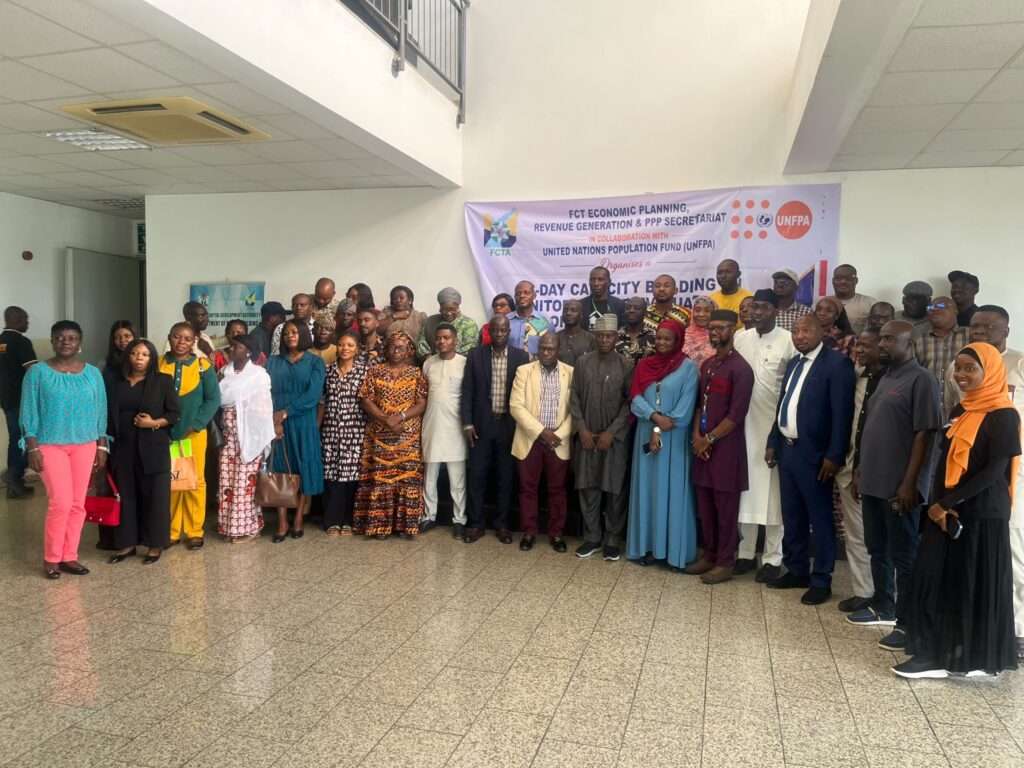
This comes as the FCTA Economic Planning, Revenue Generation and PPP Secretariat (EPRGPS) and UNFPA jointly conducted a three-day intensive capacity-building training on monitoring and evaluation for about 55 FCTA and Area Council staff last week.
Held, at the FCDA Conference Hall in Area 11, Abuja, the workshop focused on strengthening data systems that incorporate population dynamics and megatrends into policy formulation and project planning.
Project Director, Uba Bala, while speaking to Abuja Digest, stressed that the initiative aimed to equip monitoring and evaluation officers with the technical expertise needed to manage robust data systems aligned with UNFPA’s 9th Country Programme (2023–2027) and the overall development targets of the FCT.
He added that specific emphasis was placed on advancing three core transformative outcomes: ending preventable maternal deaths, eliminating unmet family planning needs, and eradicating gender-based violence and harmful cultural practices across the territory.
Underscoring the vital role of the workshop, Mr Bala explained that the intervention was designed to bridge existing operational gaps in evaluating development projects and their financing, while building the internal capacity of implementing departments and local councils to oversee interventions efficiently.
The Secretariat’s Acting Director of Economic Planning, Research and Statistics, Babashuahib Aduke, while corroborating this stance, noted that the exercise was a timely approach to equipping personnel with the key tools needed to plan and monitor projects effectively.
Aduke stressed the adoption of performance scorecards as an essential mechanism for tracking departmental outputs moving forward.
Throughout the technical modules, lead facilitator and data analyst Kazeem Abiodun Oyeyemi guided officers through data collection strategies, performance indicators, and the application of Geographic and Management Information Systems (GIS/MIS).
Oyeyemi noted a significant positive shift in participant comprehension across the three days.
Head of FCT International Cooperation, Jibril Magaji, highlighted long-term goals for institutional growth, revealing that while last week’s training comprised 55 participants, strategic plans are underway to scale enrollment to between 100 and 150 next year.
Magaji also averred that the partnership has an ultimate target of training 300 to 400 staff within the next three to five years to ensure seamless service delivery for all residents.
Reaffirming the international partner’s commitment, UNFPA representative Yusuf Bello urged attendees to establish quarterly monitoring and evaluation meetings within their respective units and maintain strict data quality assurance.
He reassured participants that UNFPA’s support remains firmly anchored on ensuring field reporting remains accurate, timely, and results-focused.
Some participants who spoke Abuja Digest reflected on the immediate practical value of the sessions. EPRGPS’s Esther Benjamin Okechukwu remarked that “knowledge is power,” while observing that key focus must now shift to navigating implementation challenges.
Nazif Baba Mohammed, a Planning Officer with the Secretariat’s International Cooperation Division, added that the exposure would directly upgrade proposal writing standards across the administration.
Mohammed noted that project success increasingly depends on well-defined inputs, outputs, indicators, and long-term impact metrics.