FCTA, UNFPA MOVE TO CURB MATERNAL DEATHS, TRAIN 25 HEALTH WORKERS ON CONTRACEPTIVES
By: Wisdom Acka and Gift Olumuji
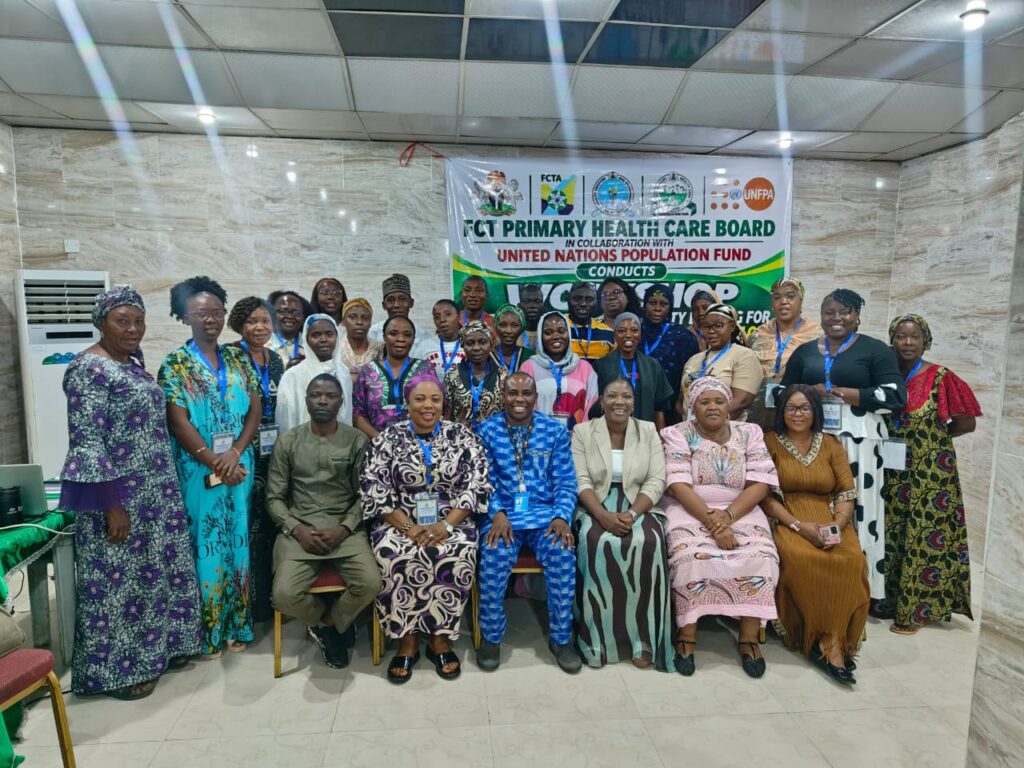
The Federal Capital Territory Administration (FCTA), in collaboration with the United Nations Population Fund (UNFPA), has commenced a five-day residential capacity-building workshop for frontline healthcare providers.
The workshop is on Long-Acting Reversible Contraceptives (LARC) to strengthen family planning delivery and curb preventable maternal deaths across the nation’s capital.
Organized through the FCTA Economic Planning, Revenue Generation and Public-Private Partnership (EPRGPP) Secretariat and the FCT Primary Health Care Board (FCT PHCB), the intensive training holds in Abuja, from November 16 to 20, 2026.
It brings together about 25 healthcare workers drawn from primary healthcare facilities and district hospitals across the six Area Councils of the FCT.
Coordinated by the International Cooperation Division of the EPRGPP Secretariat, which oversees international donor-backed projects across FCTA Secretariats, Departments, and Agencies, the workshop marks a strategic push to improve service quality and program tracking across the Territory’s grassroots health system.
Deputy Director at the Secretariat in charge of International Cooperation and FCTA/UNFPA Project Coordinator, Jibir Magaji Wudil, in his remarks at the training event, commended the implementing agencies, facilitators, and participating health workers for their commitment to advancing maternal health in the territory.
He explained that the training is designed to guarantee high-quality family planning data and services across all six Area Councils.
Wudil noted that the secretariat is actively tracking implementation to recommend targeted interventions to the FCTA, adding that additional collaborative programs with UNFPA are set to kick off following the agency’s sustained technical and financial support.
Representing the Executive Secretary of the FCT Primary Health Care Board, Dr. Dan Gadzama, Dr. Aderonke Akande who is the board’s Director of Family Health and Community Health Services, underscored that quality family planning sits at the heart of maternal survival.
She noted that many mothers die during childbirth because they conceive again before their bodies have fully recovered from a previous delivery, adding that family planning services remain completely free across all government health facilities in the territory.
“Family planning is key in saving the lives of mothers,” Dr. Akande told participants. “If you feel it’s just about inserting things and spacing children—no, you are wrong. If we want to reduce maternal mortality rates, our family planning services have to be top-notch.”
Akande described the UNFPA representative’s admonition as a wake-up call, admitting that health services in the Territory have remained overly dependent on donor partners.
Explaining that civil servants cannot publicly lead political lobbying without risking their jobs, she challenged UNFPA and Civil Society Organizations (CSOs) to spearhead advocacy to appointed political decision-makers in the FCT.
She, however, pledged behind-the-scenes technical backing from health officials to make domestic commodity funding a top priority in 2027.
Delivering a goodwill message, UNFPA representative Adedokun Oladipo outlined the agency’s “Three Zeroes” mandate by 2030 -achieving zero unmet need for family planning.
Oladipo alss outlined zero preventable maternal deaths in alignment with the agenda of the Coordinating Minister of Health and Social Welfare, Professor Muhammad Ali Pate, and zero gender-based violence and harmful practices.
He noted that Nigeria aims to raise its modern Contraceptive Prevalence Rate (mCPR) from 15 percent to 27 percent by 2030 through strengthened health systems, last-mile supply chain support, and the introduction of commodities such as the hormonal Intrauterine Device (IUD) and self-injectable DMPA-SC (Sayana Press).
Abuja Digest reports that throughout training period, participants are to undergo theoretical sessions and hands-on practicals covering national family planning standards, rights-based counseling, Youth-Friendly Health Services (YFHS), Gender-Based Violence (GBV) integration.
Others are safe insertion and removal of IUDs and implants, Infection Prevention and Control (IPC), and facility monitoring through the Health Management Information System (HMIS).
For participants, the sessions are already bridging critical clinical gaps.
Akor Blessing Emeaha, who spoke to Abuja Digest, highlighted updated dosing guidelines she has grasped for short-acting injectables.
A registered nurse-midwife, Emeaha, who revealed she attended such a formal family planning training over ten years ago, noted that three-month injectables could now be administered up to 13 weeks instead of 12, and two-month injectables up to nine weeks instead of eight.
Similarly, Otuonye Vivian of Kungabokun Primary Health Centre in Bwari Area Council, who is attending her first formal training of this scale, noted that the hands-on sessions are equipping her to confidently insert IUDs and offer proper counseling to women in her community.