FCTA, UNICEF CALL FOR STRONGER COLLABORATION AND OWNERSHIP AT THE AREA COUNCIL LEVEL TO TACKLE MALNUTRITION
… Trains stakeholders from six area councils
By: Prudence Okonna
The Federal Capital Territory Administration (FCTA) has called for stronger collaboration and ownership at the Area Council level to tackle malnutrition, strengthen food security and improve nutrition outcomes across the Territory.
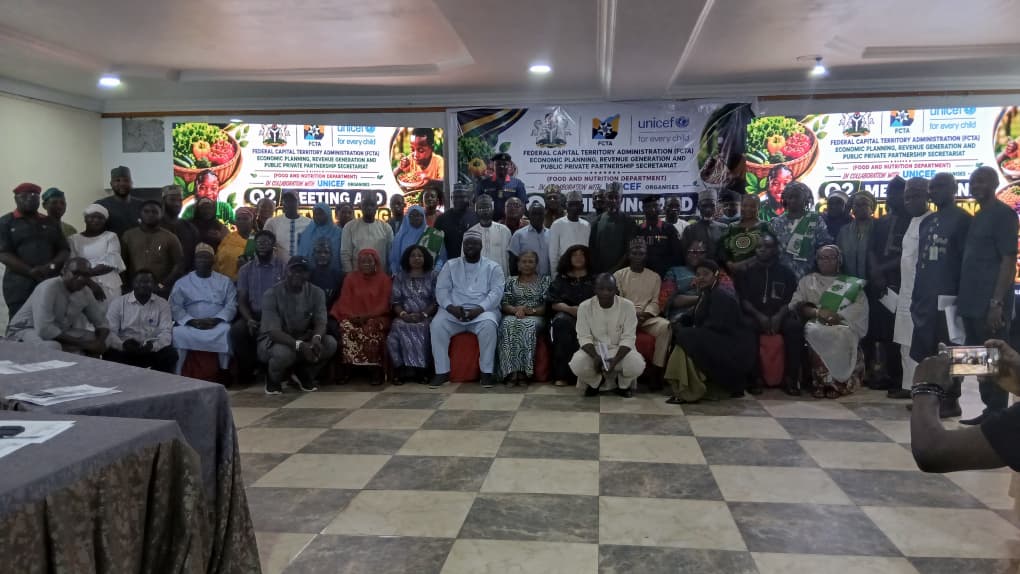
The Mandate Secretary, Economic Planning, Revenue Generation and Public-Private Partnership (EPRGPPP) Secretariat, Arc. Ubokutom Nyah made the call while declaring open the Area Council Committee on Food and Nutrition 2nd Quarter Meeting and Capacity Building.
The Acting Permanent Secretary, EPRGPPP, Uba Bala, who represented the Mandate Secretary, described nutrition security as a critical component of human capital development and economic prosperity, stressing that a healthy population remains the engine of productivity and sustainable development.
Arc. Nyah commended UNICEF for its continued technical and financial support to nutrition programmes in the FCT, noting that while policies and strategic frameworks are developed at the Secretariat level, their success is ultimately measured in wards, villages and households.
He therefore charged Area Council leadership and nutrition focal officers to take greater ownership of nutrition programmes, strengthen inter-sectoral coordination and ensure that available resources reach those most in need.
The Director, Food and Nutrition Department, EPRGPPP Secretariat, Pricess Celina Gaza-Oluwafemi, commended participants for their contributions, noting that the sessions will enhance their understanding of basic nutrition concepts, the nutrition situation in the FCT, causes and burden of malnutrition, priority interventions, the first 1,000 days of life, as well as relevant policies, governance structures and the roles of Area Council Committees on Food and Nutrition.
Adding that the sessions will also improve their knowledge of monitoring and evaluation, reporting, accountability, multisectoral coordination, the Child Nutrition Fund match mechanism and the development of practical work plans, while appreciating UNICEF, resource persons, development partners and participants for contributing to the success of the workshop.
She urged participants to translate the knowledge gained into practical actions within their respective Area Councils, stressing that they are closest to the communities where nutrition interventions are implemented.
Acting Executive Secretary, FCT Primary Health Care Board (FCT-PHCB), Dr Dan Gadzama stressed the strategic importance of the Area Council Committees on Food and Nutrition in addressing nutrition-related challenges across the FCT, noting that nutrition is particularly critical to the health and wellbeing of children and pregnant women.
Gadzama explained that while policies are developed at the national level, the implementation of nutrition programmes takes place largely at the Area Council level, making the committees essential to translating government policies and interventions into meaningful outcomes at the grassroots.
Gadzama appreciated the EPRGPPP for organising the meeting and capacity-building workshop, and UNICEF for their support. He also commended the Area Council leadership and participants for demonstrating commitment to improving nutrition outcomes across the FCT.
The representative of the UNICEF-US Department of State’s MCH Umbrella Grant (Preventing Malnutrition during the First 1000 Years of Life), Dr Chizoba Steve-Edemba, commended the FCT Administration and participants from the six Area Councils for their commitment to improving nutrition outcomes across the nation’s capital
Steve-Edemba said that the Area Council Committees on Food and Nutrition are closest to beneficiaries and therefore have a critical role to play in driving nutrition interventions, strengthening coordination and ensuring that collective goals are achieved.
She said the capacity-building programme would help participants better understand their roles within the nutrition governance structure and equip them with the knowledge and skills needed to drive food and nutrition programmes in their respective Area Councils.
Steve-Edemba urged participants to take full advantage of the sessions and apply the knowledge gained to improve nutrition outcomes in their communities.
Abuja Digest reports that the training workshop, which ran from 18 to 21 August, 2026, brought together Vice Chairmen from the six area councils, who committed to prioritise and implement nutrition policies in their area councils.
The workshop ended with the mandate secretary also inaugurating the Aid Diversion Committee for each area council to ensure transparency and accountability in managing nutrition resources and commodities.