WAFCON: CAMEROON RULE AFRICA AS NIGERIA’S FORTUNES SLIDE
By: Gyang Dakwo
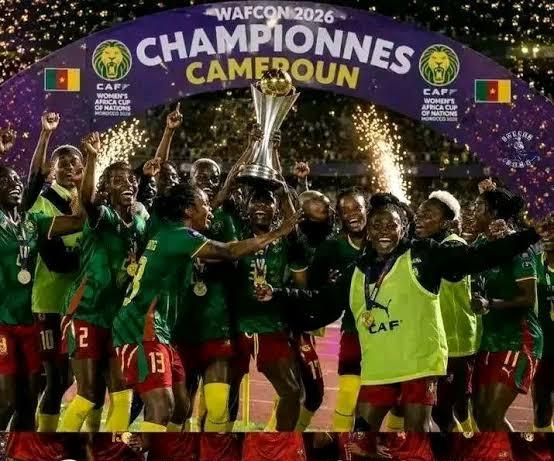
Cameroon have won their first Women’s Africa Cup of Nations title after defeating Malawi 3 – 0 in Sunday’s final in Rabat, bringing a dramatic end to a tournament that also saw Nigeria suffer its biggest setback in the history of the women’s World Cup.
The Indomitable Lionesses settled the final in a dominant first half, racing into a three-goal lead before the break. Marie Gisèle Ngah Manga scored twice, while Naomi Ndjoah Eto added the other goal as Cameroon secured their first continental crown.
The victory ended a long wait for Cameroon, who had lost all three of their previous WAFCON finals in 2004, 2014 and 2016. They had also failed to score in any of those finals.
Cameroon have now become only the fourth country to win the women’s continental championship, joining Nigeria, Equatorial Guinea and South Africa.
For Malawi, the final brought an end to an extraordinary debut campaign. The Scorchers reached the final on their first appearance at the tournament, inspired by the Chawinga sisters, and secured a place at the 2027 FIFA Women’s World Cup despite the defeat.
Cameroon’s triumph, however, was overshadowed in Nigeria by the Super Falcons’ failure to qualify for the same World Cup.
Nigeria will miss the Women’s World Cup for the first time after South Africa defeated the Falcons 2 – 1 in Casablanca on Thursday, ending their last route to Brazil through the inter-confederation play-offs.
The Falcons had been present at every edition of the women’s World Cup since the inaugural tournament in 1991. Their run ended after they lost 1 – 0 to Cameroon in the WAFCON quarter-finals, while South Africa were beaten 2 – 1 by hosts Morocco.
South Africa took control of the decisive play-off in the second half, with Thembi Kgatlana opening the scoring in the 56th minute before Refiloe Jane doubled the advantage in the 77th.
Christy Ucheibe pulled one back from the penalty spot after a VAR review, but Nigeria could not find an equaliser. South Africa goalkeeper Kaylin Swart made important saves as Banyana Banyana held on to secure their place in the next stage of the World Cup qualification process.
Nigeria’s elimination marked a sharp reversal for the most successful team in WAFCON history. The Falcons have won the continental title 10 times and had never previously failed to qualify for the global tournament.
Their setback has also added to growing concerns about the state of Nigerian football. The Super Eagles have already failed to qualify for the last two editions of the men’s World Cup, missing Qatar 2022 before losing to the Democratic Republic of Congo on penalties in the African play-off for the 2026 tournament.
The contrast with the progress of other African teams is becoming harder to ignore. Cameroon have finally converted years of near misses into a continental title, South Africa have emerged as a major force in women’s football, while Morocco have also established themselves among Africa’s leading teams.
Nigeria’s position at the top of African football is no longer as secure as it once was. The Falcons’ historic World Cup absence, coming alongside the Eagles’ successive failures, has exposed a decline that goes beyond individual matches and raises questions about the preparation, development and administration of the country’s national teams.
For Cameroon, Sunday’s victory marked the beginning of a new chapter. For Nigeria, the tournament ended with the loss of a record that had survived every previous edition of the Women’s World Cup.